




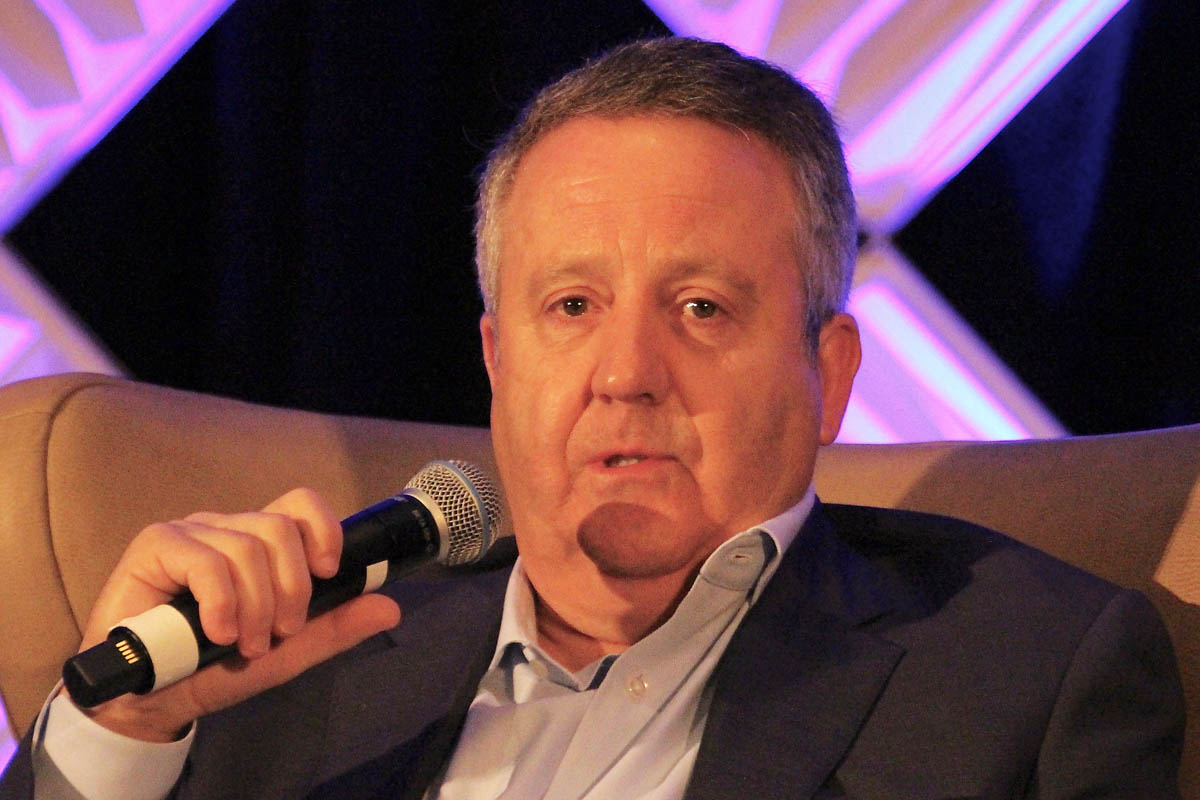
“We have this common-carrier obligation to provide freight service to all customers in all markets,” said Rose, BNSF Railway’s executive chairman, during a Monday morning “fireside chat” at the annual National Railroad Construction and Maintenance Association conference. “And what we’re doing in PSR is we’re redefining what we’re willing to accept in the freight railroad industry on certain lanes. And I really do believe we’re going to get in a lot of trouble by doing that.
“What the [Surface Transportation Board] allows us to do is what we call price differentiate,” he said, illustrating with an example of airline passengers in adjacent seats who may have paid significantly different fares depending on when they bought the ticket. “We get that same right, but we have to carry you from Point A down here to Florida. If the airlines say, ‘We’re not going to provide service to that market,’ I think they’d get in trouble. I think the freight rails will get in trouble doing that.
“… When you start redefining markets, I think then the federal policy makers will look at this, and quite frankly, they will not be happy with us.”
Rose also expressed doubt that Precision Scheduled Railroading – the approach championed by the late Hunter Harrison at Canadian National, Canadian Pacific, and CSX Transportation – ultimately provides the service improvements claimed by some of its adherents. To illustrate, he pointed to interline service agreements between railroads: “When two railroads do business with each other, we make a commitment that we’re going to deliver to the gateway at X time on X days.
“We do business with railroads that are fully impiemented from a PSR standpoint, and I don’t see any improvement in our ISA’s with them. Zero. When I look at how those railroads do with commuter rail or passenger rail service, I don’t see any improvement … I don’t hear any customers jumping up and down talking about how service is so much better on any railroad. In fact, I would tell you it’s just the opposite, when I look at what the network is really doing.
“And I think the point that I’m trying to make is, when railroads say we’re no longer to serve these markets, one railroad may be able to get away with it, because then everybody can point to, well, the other railroads are going to get the business.” If other railroads follow suit, he said, “then trust me, there will be a whole series of hearings in D.C. on this.”
Rose, who will retire in April as BNSF’s executive chairman, made it clear he feels extremely fortunate to have led a railroad that, as part of Berkshire Hathaway, has been insulated from much of the quarter-to-quarter scrutiny faced by the publicly traded railroads.
He recalled shareholder presentations prior to BNSF’s acquisition by Warren Buffett’s company.
“You’d meet with two people from Fidelity, and there’d be 20 other people. And all they were trying to do was understand what was going to happen the next quarter,” Rose said. “… These are assets that we hope are going to live for 20, 30, 40, 50 years, and you’ve got some kid who just got out of college asking, ‘What’s your earnings going to do next quarter?’ You know, like who cares?”
In contrast, being part of Berkshire Hathaway – “they’re public, but it feels like being privately held,” he said – has been “unbelievably refreshing.”
To illustrate, he called a year when the sudden growth of crude-by-rail traffic was swamping BNSF at a time when it had already announced its largest-ever capital spending plan, some $5.2 billion. Eventually, he called Buffett and said he needed to spend another $500 million on capital projects.
“He said, ‘Well, that’s why you’re the CEO.’ That was it. In other words, I’m not going to say yes. I’m not going to say no. Here’s a rope; go hang yourself. Have a good day.
“If we were publicly traded at that time, I would have had to have a board call. I would have had to spend days going through resolutions. I then would have had to file an 8-K. I probably would have had an analyst call. The stock probably would have had the tar beat out of it, for spending more money on the railroad.
“It’s a whole different deal. And really, I wish all of these railroads were out of the public markets, but that’s not the reality. And it’s unfortunate for some of them.”
It’s also unlikely that any other railroad will be taken private any time soon, he said – or that there will be any mergers. In both cases, the railroads’ values work against them.
“When Warren finally came along in 2009, the market cap was $27 billion; he took us out at $36 billion,” Rose said. “Today, these market caps are unbelievable.” A railroad like Union Pacific, he noted, might have a value over $100 billion. “So when you think about a private equity coming in and buying one of these public railroads, it’s a big, darn deal. I don’t think it’s going to happen.
“The second question is are conventional mergers still viable, and there, I think the answer is the same. For one railroad to buy another, you’d have to borrow $100 billion, $70 billion, something like that. These are staggering numbers. … it would be really hard to fund a merger like that. And then you’ve got this whole regulatory issue I think this next merger of two Class Is will trip off, which will have a whole set of destructive issues that would come to the railroad industry – things like forced access, exceptions that the STB covers, competitive line rates – all these things I think would be very harmful to the industry.
“So I don’t think the public litmus test is ready to accept that we need more rail mergers.”
Rose said he does not yet know what he will do after he retires from BNSF.
“I’ll probably do something in public policy,” he said. “I’m going to look at a lot of things. I may do something in private equity. I don’t know.