




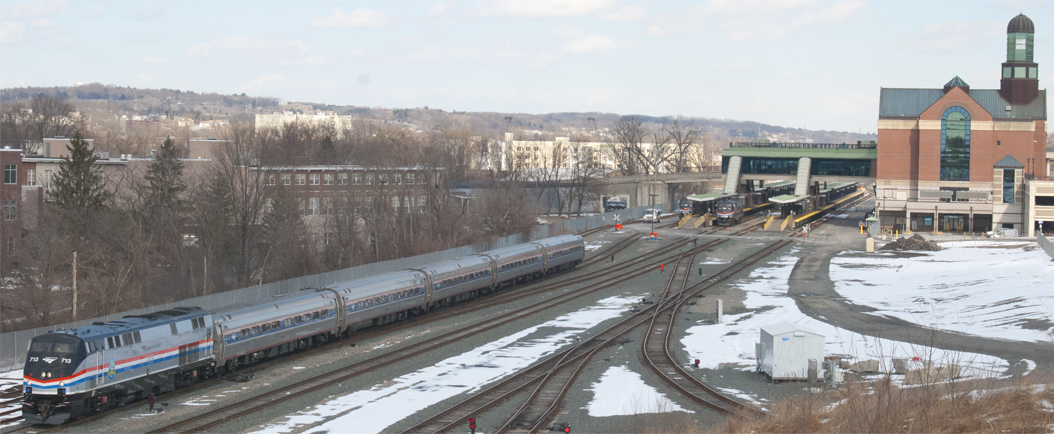
The Berkshire Flyer would start as a seasonal, weekend train running between New York Penn Station and Pittsfield, Mass. The key connection point would be Amtrak’s Albany-Rensselaer, N.Y., station, where the north-south Empire Corridor connects with the east-west line to Boston. One train would run from New York to Pittsfield on Friday, and another would run the opposite way on Sunday. The service would run from Memorial Day through Columbus Day weekends. A ticket would cost about $70 each way.
The pilot project grew out of a desire to boost tourism in the western part of Massachusetts, says state Sen. Adam Hinds, D-Pittsfield.
“One priority has been linking the region with regional economic centers,” Hinds says. The area is home to attractions such as the Tanglewood music venue and the Massachusetts Museum of Contemporary Art.
Berkshires officials had for years contemplated establishing passenger service to New York City using Housatonic Railroad tracks that run from Pittsfield through Connecticut, Hinds says. Estimates to bring the line up to code for passenger rail service were $300 million.
About two years ago, Hinds says he learned that since Amtrak connects Pittsfield to Albany- Rensselaer through the daily Lake Shore Limited, it might be possible to use those tracks to run trains that would continue to New York City. He introduced legislation in 2017 directing the Massachusetts Department of Transportation to create a working group to study the feasibility of service that would use Empire Corridor tracks as the backbone for service to Pittsfield.
“They reported back that it was, in fact, feasible, would be beneficial economically, and would require no new capital investment for the infrastructure,” Hinds says.
Hinds says DOT then told the group it would need to answer questions before a pilot could be established: 1.) How would the group handle the “last mile,” when someone arrives in Pittsfield without a car and needs transportation; 2.) What is the plan to market the train; and 3.) What is the financial plan?
The just-released report contains the group’s answers. It identifies car and shuttle availabilities, marketing strategies, and the costs for the pilot. The group projects it will cost $421,561 to start the program in June 2020. That would be offset by ticket revenue of $184,000, leaving $237,561 to be raised elsewhere. Hinds says he’s hopeful a combination of federal, state, and local funding will be obtained to launch the program.
The group is also working to determine a sponsor for the program, Hinds says. This would be an entity that would be the point of contact for companies such as Amtrak and CSX Transportation, which owns portions of the trackage, as well as governmental agencies and private companies that will be dealing with the project. The working group included a representative from Amtrak, who has indicated that the railroad could work the Flyer into its schedule.
The sponsor will also be key to marketing the program, says Thomas Matuszko, executive director of the Berkshire Regional Planning Commission, one of the local groups that is helping to coordinate the project. Given that the pilot program is set to last for two years, “in order for it to continue on, there has to be the ridership. For that to happen, there has to be some pretty strong promotional efforts going on,” Matuszko says.