




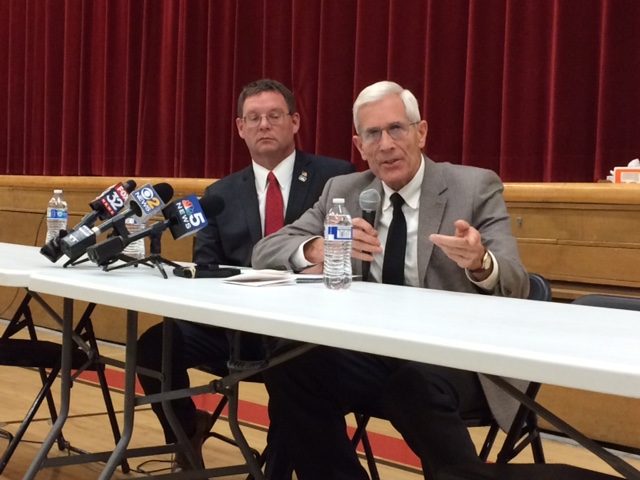
U.S. Rep. Daniel Lipinski, D-Ill., whose Third District covers much of the area served by Metra’s BNSF Line, promised to hold Metra and BNSF officials’ “feet to the fire” to improve service.
“We all understand that problems can occur, but this year the Metra BNSF line has failed all too often. There have been repeated delays, cancellations, broken air conditioners, and other problems,” Lipinski said at a public meeting he organized in suburban Western Springs. “”I’ve told Metra and BNSF that this is unacceptable and the problems must end.”
Metra CEO James Derwinski and BNSF Vice President for passenger operations DJ Mitchell repeatedly apologized to an audience of about 80 people, and promised that they would do their best to address problems on the line.
“This is very important to us,” Derwinski said. “No one wants to hear excuses.”
Mitchell pointed out that while he is based in based in Fort Worth, Texas, where BNSF is headquartered, he was once a resident of the area and rode the line.
“Lately, I haven’t been so proud” of the service, he said.
Mitchell also promised to hold future “town hall meetings” with the public to address complaints and report on progress. He told members of the audience they could email him with their concerns, and announced his address.
The BNSF Line is the busiest of Metra’s 11 lines, carrying 64,000 riders a day between Chicago Union Station and Aurora. It operates on BNSF-owned tracks with BNSF crews. But the line’s on-time performance has hovered around 91 percent, well below most of Metra’s other lines and below Metra’s stated goal of 95 percent.
This past year was especially problematic, with installation of positive train control on the busy rail line, which sees 94 Metra trains, 12 Amtrak runs, and as many as 60 freight trains a day.
Installation of PTC prompted rescheduling of trains to accommodate longer turnaround times. The new schedule was blamed for overcrowding, delays and the disruption of passengers’ habits. Most of the audience at the 90-minute hearing cited these complaints.
“I have nowhere to sit,” said one woman, who said she was pregnant. “You have to address the overcrowding issues.”
Adding to the discontent were repeated breakdowns of the air conditioning units on the “Eisenhower-era” coaches that Metra says it cannot replace without additional funding from the state of Illinois. The state legislature has not approved an infrastructure funding measure since 2009.
Derwinski said Metra operates with the oldest coaches and locomotives of any commuter line in the U.S., but he said the railroad has been efficient and cost-effective in rehabilitating the equipment.
Mitchell appeared before Metra’s board of directors in August and vowed to come up with a plan to eliminate the overcrowded and overheated cars.
Lipinski, who is also co-chair of the House Public Transit Caucus, said he has asked the Surface Transportation Board to oversee operations on the line. But he acknowledged that the STB’s authority does not extend over commuter railroads.
Lipinski said he was grateful for the Metra and BNSF officials to attend the meeting and address passengers’ concerns.
“And they both know that I will continue to hold their feet to the fire until we get the service that we deserve,” Lipinski said.