




And what will the state defined most by coal and railroads — West Virginia — do with a continued slide? Unlike out of work railroaders and miners, it can’t pick up and find work in a city somewhere.
Diversification is key – but can railroads benefit?
“While we diversity our state’s economy, we must take advantage of our location and existing infrastructure to recruit and develop businesses that rely on rail transportation to move their products,” West Virginia state Sen. Bill Cole, a Republican, tells Trains News Wire. “This includes a manufacturing strategy to revitalize our product output and making our state a warehouse hub for distribution.”
Cole says West Virginia and the railroads that serve it face difficult economic times. During the state’s ongoing legislative session, policymakers are looking at ways to make the state more attractive to large businesses through regulatory reform and right-to-work legislation. Cole, who also serves as the state senate president and lieutenant governor, says now is the time to take advantage of West Virginia’s extensive railroad main lines and branches.
CSX Transportation has done this in part by using its former Chesapeake & Ohio main line to move intermodal trains between North Baltimore, Ohio, and Portsmouth, Va., but some say those are only short-term routings that will be abolished once CSX finishes its National Gateway Project.
Norfolk Southern recently opened its Prichard, W.Va., intermodal complex south of Huntington, W.Va., as part of the Heartland Corridor Gateway on the route of its Kenova District between Portsmouth, Ohio, and Williamson, W.Va. While coal dominates the route, NS does use the main line for run-through merchandise freight, unit grain, ethanol, autorack, and intermodal trains. Double-stack clearances indicate NS has adjusted to business beyond black diamonds.
Justin Gaull, vice president of economic development at the Charleston Area Alliance says that “there is an opportunity for southern West Virginia to connect its manufacturing and distribution businesses with the Prichard Intermodal facility, and perhaps a few businesses could be linked to the to the facility exclusively via rail using existing rail infrastructure.”
“As coal-related rail traffic declines, West Virginia will have an opportunity to analyze its inventory of available rail and land assets to leverage new marketing opportunities for manufacturing and distribution locations,” Gaull says.
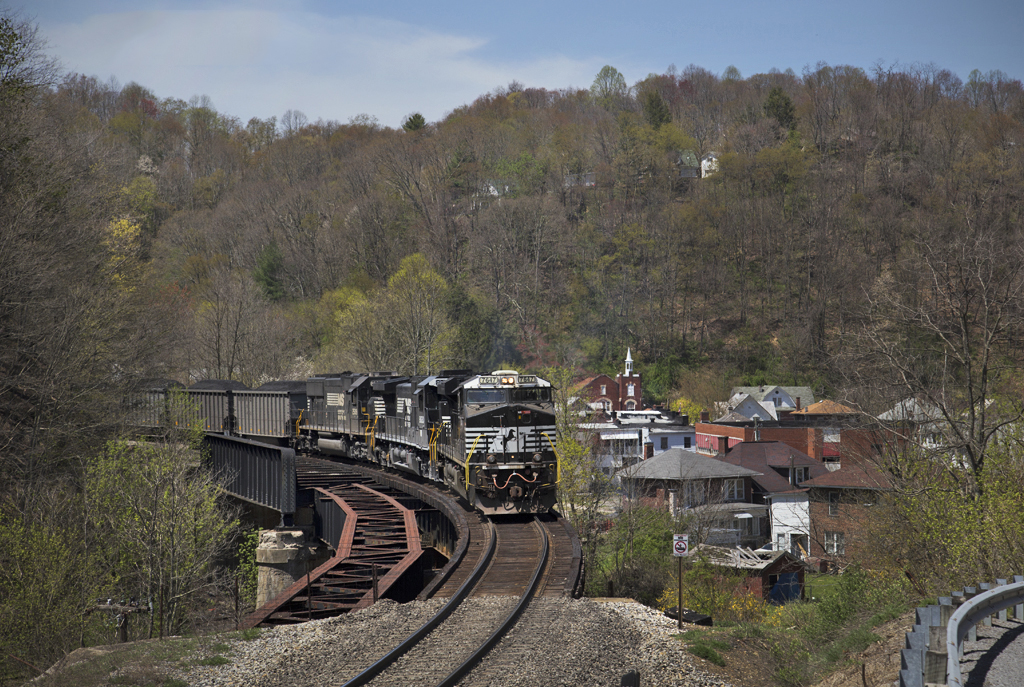
While mainline routes could be salvaged for run-through traffic and local industries, there is an open question for what is in store for the future of the more than 500 miles of coal-exclusive branch lines served by both Class I railroads and a handful of struggling short lines? Locals believe that as coal companies idle their assets in rural, geographically strained regions of southern West Virginia, the current branch lines will join the countless others that have fallen into abandonment.
Other groups are coming together to preserve West Virginia’s coal heritage in a way that embraces another significant economic contributor — tourism.
The New River Gorge Regional Development Authority is looking at using the rails of a former Chesapeake & Ohio coal branch to illustrate the importance of preserving the state’s coal heritage.
Christine Kinder, the authority’s Raleigh County, W.Va., extension agent for community development says that the authority is interested in using 15.2 miles of rail line recently abandoned by CSX Transportation for recreational use. The railroad recently filed an official notice to abandon the Jarrolds Valley Subdivision from near Whitesville, W.Va., to Clear Creek, W.Va.
One of the ideas currently on the table is to use the line as a traditional rails-to-trails for recreational purposes. Another option is to keep the rails in place and bring foot-pedaled rail carts to the old branch line.
Kinder says the concept is popular in Austria and Germany and that it “presents an outstanding tourism opportunity that would create a destination.”
Kinder says that intact rail for recreational use is largely unheard of in the United States. A recent feasibility study of the Draisine Tour, funded by the Raleigh County Commission and National Coal Heritage Area has been completed. Concord University’s Department of Tourism recently administered a visitor’s survey that showed encouraging results, according to Kinder. The Raleigh County Commission has since filed a notice of intent to apply for a Recreational Trails grant of $150,000 for purchase of the branch line. Applications are due in March and the commission will be required to make a 20 percent match.
While coal declines will further shape the condition of the state’s extensive rail network going forward, opinion leaders seem to want to stay open minded in an effort to re-invent the state’s business model beyond coal production. Whether finding a new use for manufacturing or tourism, until the industry stabilizes, it remains to be seen exactly which railroads will rebound from coal and how that undertaking will be executed.